




In the race for digital transformation, speed and agility have become the currency of modern business. DevOps, a cultural and technical movement emphasizing collaboration between Development (Dev) and Operations (Ops), revolutionized software delivery by automating pipelines and accelerating release cycles. However, as release frequency increased, a critical challenge emerged: how do organizations maintain security and compliance when moving at the speed of DevOps?
The answer lies in DevSecOps, the strategic evolution that integrates security into every phase of the continuous delivery pipeline. For businesses navigating a hyper-competitive, threat-rich environment—especially those adhering to stringent regulatory frameworks like NCA and SAMA in the Saudi market—understanding the fundamental difference between devops and devsecops is essential for strategic success and survival.
This article delves into the core philosophies, processes, and tools that separate these two paradigms, illustrating why DevSecOps is now the mandatory standard for building robust, high-trust applications.
Understanding DevOps: The Pursuit of Speed and Efficiency
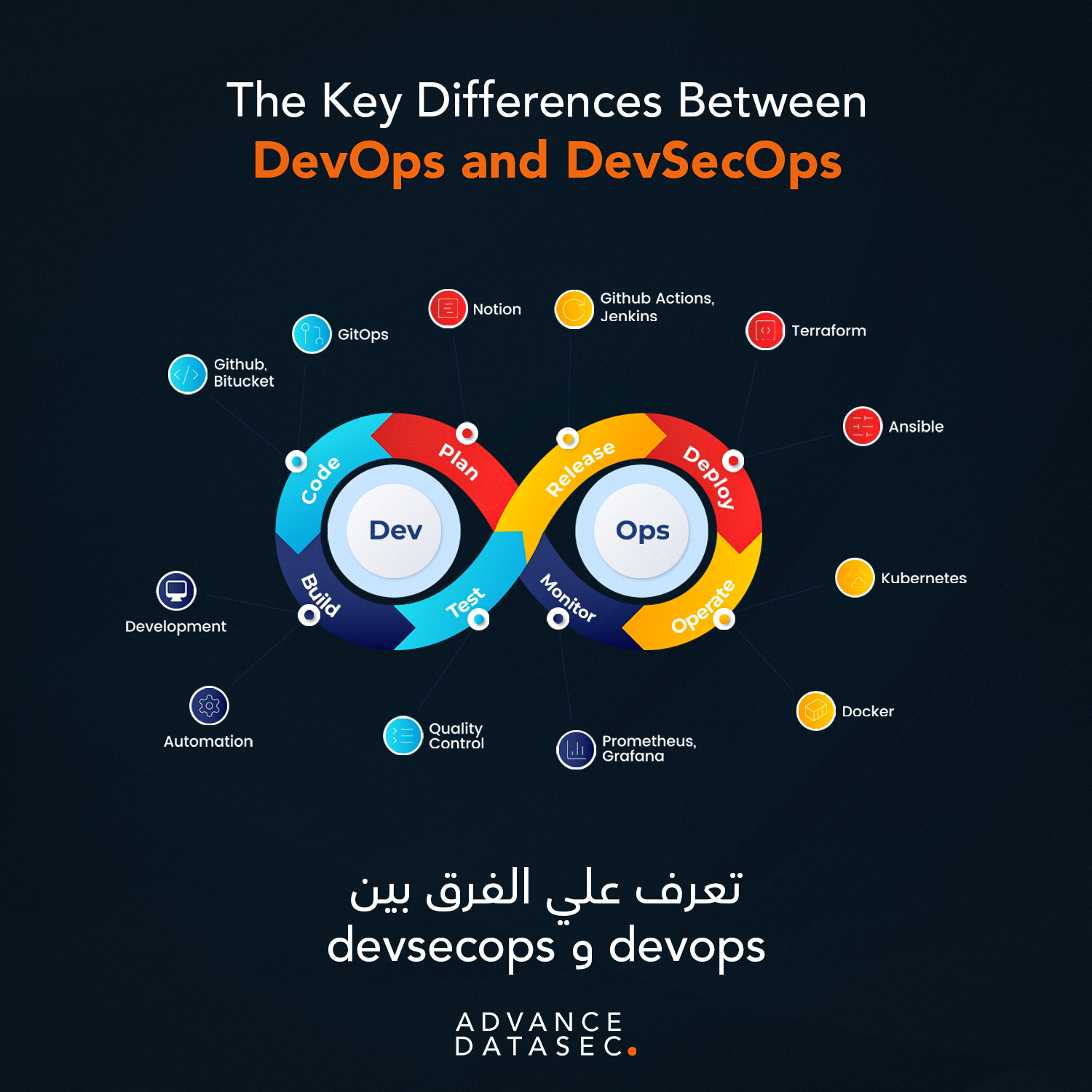
DevOps arose from the necessity to break down the traditional walls between development teams (who build code) and operations teams (who deploy and maintain it). Its primary goal is to increase the organization’s velocity and stability through automation and continuous feedback.
Key Tenets of DevOps:
- Collaboration: Fostering a shared responsibility for the entire software lifecycle.
- Automation: Using Continuous Integration/Continuous Delivery (CI/CD) pipelines to automate building, testing, and deploying code.
- Continuous Feedback: Implementing monitoring and logging to rapidly identify and fix operational issues.
- Infrastructure as Code (IaC): Managing and provisioning infrastructure using code and automation tools (e.g., Terraform, Ansible).
While DevOps excels at merging Dev and Ops to achieve unparalleled speed, it often inherits a critical flaw from its predecessors: it treats security as a separate, often manual, step. In many pure DevOps implementations, security remains “shifted right”—a gate that the application must pass before or immediately after deployment, leading to bottlenecks and late-stage, costly vulnerability remediation.
The Core Challenge: Why Security Needs Its Own ‘Ops’
The inherent speed of DevOps creates a temporal conflict with traditional security practices. When a development team pushes dozens of code changes daily, a security team cannot keep pace by conducting weekly or monthly manual penetration tests. This disparity results in a critical risk: vulnerabilities are inevitably deployed to production simply because the security checks could not be automated or executed in time.
The failure to automate and integrate security tools early led to the realization that mere speed without security is reckless. This is the moment the industry recognized the vital difference between devops and devsecops: one prioritizes rapid delivery, and the other prioritizes rapid and secure delivery. DevSecOps formalizes the shift of security responsibilities and activities “to the left,” embedding them into the automated pipeline itself.
Defining DevSecOps: Security “Shifted Left”
DevSecOps is not a separate methodology; it is the natural, necessary enhancement of DevOps. It integrates people, processes, and tools to make security a shared, continuous responsibility throughout the entire Software Development Lifecycle (SDLC). The goal is to move security controls from checkpoints and manual reviews to automated, proactive mechanisms.
The core principle is “Security as Code,” meaning security policies, configurations, and testing are defined, automated, and executed just like functional code.
Key Components of a DevSecOps Pipeline:
- Security Automation: Automatically running security tools within the CI/CD process.
- Threat Modeling: Conducting risk analysis during the planning and design phase.
- SAST/DAST Integration: Using Static Application Security Testing (SAST) and Dynamic Application Security Testing (DAST) tools to scan code and running applications in real-time.
- Secrets Management: Ensuring keys, credentials, and tokens are stored securely and not hardcoded.
- Compliance Checks: Automating checks against internal security policies and external regulations (NCA ECC, SAMA CSF).
The primary difference between devops and devsecops is therefore the mandatory inclusion of these security components, making security failure a blocker in the build pipeline, not a discovery after deployment.
The Fundamental Difference Between DevOps and DevSecOps: Culture and Controls
While both methodologies share a foundation of automation and collaboration, the crucial difference between devops and devsecops can be broken down across three strategic dimensions:
| Feature | DevOps (Traditional) | DevSecOps (Modern) |
| Security Philosophy | Security is a separate function; often a manual, late-stage gate (Shift Right). | Security is everyone’s responsibility; integrated, continuous, and automated (Shift Left). |
| Cultural Mindset | Focus is on the speed of delivery and feature functionality. | Focus is on “Secure Speed” and building high-quality, trustworthy code from the start. |
| Pipeline Integration | Focus on functional and unit testing. Security tools are optional or external. | Mandatory integration of security tools (SAST, DAST, SCA) into the CI/CD pipeline, often blocking builds if critical vulnerabilities are found. |
| Code Review | Primarily focused on code quality, performance, and functionality. | Includes mandatory security checklists and automated vulnerability scanning during every pull request. |
The most significant difference between devops and devsecops is that in DevSecOps, security is no longer the team that says “No”; it is the tooling and automation that empower the development team to say, “Yes, this code is secure and compliant,” with evidence. This shift eliminates friction, allowing security to enhance, rather than impede, velocity.
Strategic Advantages of DevSecOps for the Modern Enterprise
Moving to a DevSecOps model offers tangible benefits that go directly to the bottom line, especially in security-conscious markets:
- Accelerated Compliance: By automating compliance checks against regulatory frameworks (NCA, SAMA), organizations gain continuous assurance and dramatically reduce the effort required for audits.
- Reduced Cost and Risk: Finding and fixing vulnerabilities in the coding phase is orders of magnitude cheaper than fixing them in production.
- Enhanced Application Resilience: Continuous security testing builds inherently more resilient applications, reducing the likelihood and impact of a costly breach.
- Faster Time-to-Market: By automating security, the pipeline moves without the manual delays associated with traditional security reviews, achieving secure speed.
The difference between devops and devsecops marks the transition from reactive damage control to proactive security excellence.
Conclusion
DevOps provided the blueprint for high-velocity software delivery, but DevSecOps delivers the security required for that velocity to be sustainable and responsible. The crucial difference between devops and devsecops is not merely adding a tool; it is a profound cultural and procedural change that weaves security into the very fabric of application creation. For any organization striving to protect its digital assets, achieve rapid, compliant releases, and maintain customer trust, DevSecOps is the necessary future of development.
Ready to mature your delivery pipeline and transform your security posture? Contact Advance Datasec today for expert DevSecOps consulting and implementation services designed to integrate security automation seamlessly into your CI/CD pipeline, ensuring full compliance with regional regulations.
For more articles: